Ask most security leaders what their organization is doing with AI, and you will likely hear a familiar answer: they lack visibility into what employees are asking AI or what data the AI is accessing.
That is an uncomfortable reality, but it actually undersells the core problem. The hardest issue isn’t the AI activity you cannot see; it is the AI attack that your existing security stack will look at directly, evaluate incorrectly, and wave right through.
Traditional Security Information and Event Management (SIEM) systems and traditional SOCs were built for deterministic systems. AI systems process natural language, make independent decisions, and execute actions across your environment.
Here is how SAF3AI redefines enterprise AI security by shifting from fragmented point tools to a unified detection fabric.
The Gap: The Attack Your Security Stack Will Approve
Consider a multi-stage AI campaign that plays out over several days. The threats that matter most in AI often accumulate over time rather than announce themselves loudly.
- It plants: A shared document arrives carrying a hidden, indirect prompt injection. Real-world exploits like EchoLeak (CVE-2025-32711) have proven that zero-click vulnerabilities can use embedded instructions to quietly bypass guardrails.
- It triggers: An enterprise assistant summarizes the document, causing the payload to quietly rewrite the model’s instructions.
- It blends: Over the following days, the agent makes individually unremarkable tool calls, slowly drifting its retrieval toward sensitive finance folders.
- It stages: Data leaves the environment as harmless-looking markdown image URLs, fragmented and split across multiple sessions.
- It pivots: The bad actor probes a second AI surface, hunting for the weakest guardrail in the organization.
Look at what each control in a mature security stack sees during this campaign. An inline guardrail scans each prompt individually; because no single request crosses a malicious threshold, it allows the action. Data Loss Prevention (DLP) tools never fire because the exfiltration is fragmented over days.
The SIEM logs the events, but because there are no traditional signatures for these novel LLM techniques, the logs land unscored and uncorrelated.
The net result is five isolated “allow” decisions and zero incidents. SAF3AI was built to solve this exact gap.
Detection as a Common Fabric
SAF3AI’s answer is architectural. Rather than bolting another point tool onto a specific surface, SAF3AI places a single detection-and-scoring layer underneath every AI surface in the enterprise.
Every log—whether from Microsoft 365 Copilot, Google Workspace Gemini, OpenAI, or a custom agent—crosses the same substrate, is scored on the same scale, and is correlated into the same incidents. This unified fabric closes the security gap along four distinct dimensions:
- Dual-Channel Visibility: Both natural language conversations and backend tool-call executions are tagged and scored on every signal.
- Temporal Memory: Risk states are tracked over days and weeks. Multi-turn jailbreaks and low-and-slow campaigns accumulate visibly instead of disappearing between isolated prompts.
- Unified Identity Resolution: SAF3AI tracks a single resolved human actor across every surface. When the same actor escalates across a productivity assistant, a custom agent, and a shadow tool, SAF3AI sees a single campaign subgraph rather than unrelated sessions.
- Agentic Reasoning on Escalation: When an incident escalates, an automated LLM loop reads the entire trajectory to gather evidence and generate an incident summary. No prior static signature is required to catch a novel technique.
If you run that same five-stage campaign through the SAF3AI fabric, the outcome inverts. The system’s agentic loop recognizes the chain of injection, drift, staging, and pivoting, automatically opening a highly scored incident mid-campaign.
Governance Across Every Surface You Actually Use
Security is only effective if it covers the entire attack surface. SAF3AI is built to observe and govern the complete enterprise AI footprint, which includes:
- Productivity Assistants: Out-of-the-box integrations for tools like Microsoft 365 Copilot, Gemini Enterprise, and Anthropic.
- Low-Code and No-Code Platforms: Visibility into platforms like Copilot Studio and AppSheet, where citizen-developers deploy templates without central oversight.
- Custom Cloud Agents: Security for developer-built agents running natively on Google Cloud, AWS, or Azure, covering frameworks like LangChain.
- Endpoint and Coding Agents: Monitoring for device or browser-based AI applications, including Cursor and ChatGPT.
Extending the SOC, Not Replacing It
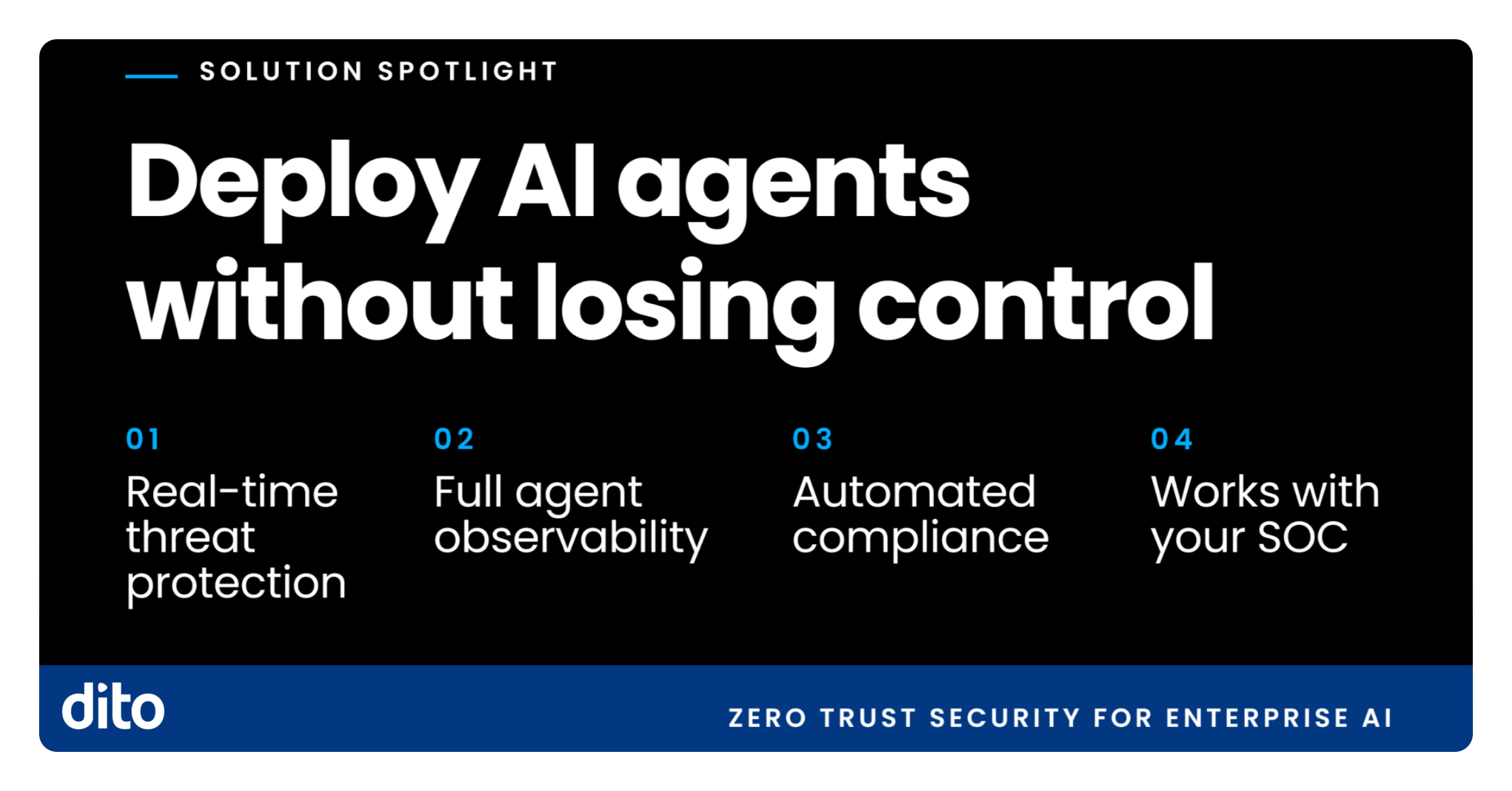
SAF3AI does not aim to replace your existing SOC; it extends it. It runs the workflow your team already relies on – detect, triage, investigate, and respond – and translates AI-specific threats mapped to the OWASP LLM Top 10 and MITRE ATLAS frameworks into actionable intelligence.
The enriched, correlated signals flow seamlessly into your existing SIEM and SOAR tooling (like Google SecOps, Splunk, or Sentinel).
Furthermore, SAF3AI delivers tangible business value beyond immediate threat detection:
- Deployment Flexibility: The platform offers SaaS, hybrid on-premise, and highly restricted air-gapped (sovereign) deployments, ensuring sensitive data remains sovereign.
- Automated Compliance: It provides audit-ready reporting mapped directly to frameworks like SOC 2, HIPAA, GDPR, ISO 42001, and the EU AI Act.
- FinOps and Cost Control: Token and API spending is tracked by team, project, and individual user, allowing you to set budgets and receive alerts before costs spiral out of control.
The organizations moving fastest on agentic AI are not the ones with the most permissive policies; they are the ones who can definitively prove what their agents did and catch a malicious campaign while it is still in motion.
Recent Posts
On-Demand